Shopping Cart

A matter of shape
Pick shape matters. Overall surface affects how you hold it; the tip affects tone and playability. So you choose your pick based on your music and your playing style.
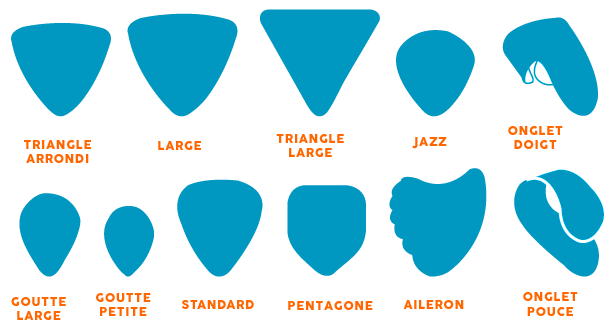
To clear the ground, here are a few general points on pick shapes that can guide you:
- wide picks are perfect for guitarists with grip issues, or for bassists ;)
- jazz picks suit players who want perfect control (in jazz as well as metal), or who want to keep light finger contact with the strings
- standard picks suit many guitarists, especially in rock or blues
- shark-fin shaped picks offer many different contact surfaces and are ideal for varying sonic effects
- teardrop picks are ideal for jazz. They offer a warm, round tone
- thumb picks let your thumb carry the accompaniment line, while fingerpicks are perfect for fingerpicking
 Choosing materials
The big plastic family
- Celluloid: used since the first plastic picks. They produce a balanced tone and a bright attack. Perfect for acoustic rhythm thanks to the high harmonics they generate and the slick feel on the strings.
- Nylon: very flexible and used for the thinnest picks. They produce a very bright tone.
- Delrin (Acetal) / Delrex: Tough and versatile. Used both in a matte texture (slight grip) for Dunlop’s famous Tortex, and in a smooth, glossy finish on many other picks (a subtler attack than matte).
- Ultem (Ultex): Very stiff. Produces a bright tone with a strong attack. Picks made from this material are virtually indestructible and very light.
- Lexan: Known from Dunlop’s Stubby range. A transparent material that resembles glass. Lexan is perfect for thick and extra-thick picks. It does wear faster, though.
- Polycarbonate: A tough polymer stiffer than nylon and celluloid. Smooth surface. Moderately bright attack.
Wood
Back in force in recent years (notably with maker Dugain), each wood species has unique behaviour and sonic signature. Wear against the strings softens the attack edge to your playing style for an almost personalized sound.
The softer the wood (lower density), the warmer the tone — but the pick wears faster. Here is a ranking of species by density, from lowest to highest:
Holly > Service tree (alisier) > Rosewood > Boxwood > Ziricote > Olive > Rosewood (palissandre) > Purpleheart > Pernambuco > Ebony > Snakewood > Kingwood > Lignum vitae
Horn, coconut, bone
- Compared with wood, horn is especially suited to flexible, soft playing
- Coconut produces a brighter tone than wood species and is also more durable
- Bone produces a bright, rich, powerful tone with high wear resistance
Metal
Very specific! Offers a… metallic tone (as you would expect) with a very sharp attack and very high harmonics. Behaviour changes with the metal (stainless steel, bronze, copper, brass). Stainless is the most durable, bronze the most “jazzy”, copper and brass the “softest”.
Stone
Stone picks absorb no harmonics and produce a very bright tone. Stone has unique resonance properties.
 How thickness affects feel:
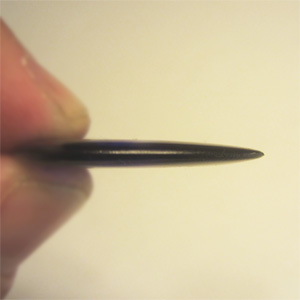
Thickness has a direct impact on pick flexibility, and each material behaves differently at the same thickness, so comparing ranges is tricky.
Thicknesses fall into five families:
- Extra-light / Thin: under 0.45 mm. Used for delicate acoustic playing.
- Light / Thin: between 0.45 mm and 0.70 mm. Ideal for accompaniment and chord strumming.
- Medium: between 0.70 mm and 0.85 mm. The most standard thickness range.
- Heavy: between 0.85 mm and 1.50 mm. Better suited to electric guitar
- Extra Heavy: over 1.50 mm. For players who want precision — whether jazz or metal!
To find the thickness that suits you best, you will need to try mixing picks of different thicknesses and materials.
 But the tip and profile have the last word
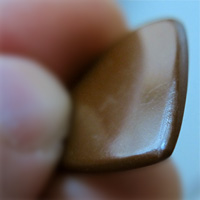
The tip is the first part of the pick to contact your strings — and your tone! That influence really shows on thicker picks, i.e. once they start to get stiff.
- A pointed tip is better for solos/leads because you can play faster. The attack will be brighter.
- A rounded tip offers a softer attack and is easier to play, but with less lead speed. Ideal for strumming chords.
Profile also affects feel and tone. A more rounded profile lets the string slip off more easily. A sharper profile offers more playing precision.
In summary!
Now you know everything about picks. To finish, here is a short summary ranking materials from the warmest tone and softest attack to the most precise attack and brightest tone:
Felt > Wood > Acetal > Delrin > Celluloid > Nylon > Polycarbonate > Lexan > Ultem > Acrylic > Stone > Metal