
Shopping Cart

Your electric guitar strings play a major role in your tone. The type and quality of materials, the diameters in the set (the gauge), and the brand all affect how your instrument performs and sounds. A good guitar is only about a third of a great tone; the amp and your strings matter just as much. Here are a few points to help you choose electric guitar strings.
 Gauges and tension
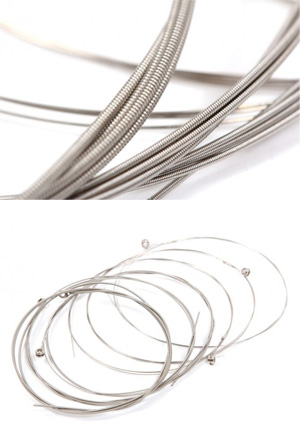
The gauge of an electric guitar string set refers to the diameters of the strings in the set. Gauge is usually given as the diameter in thousandths of an inch of the thinnest string and the thickest string.
For example: for a 10-46 gauge, the thinnest string is 0.010" and the thickest is 0.046" (1" = 2.54 cm)
The set details also list the diameters of the other strings. Those diameters are chosen based on the two extremes to offer the best compromise of tension, playability, and tone (in standard tuning).
Your electric guitar string gauge therefore directly affects string tension and playability, as well as string mass — and thus magnetic output and the signal level from your pickups.
Which gauge to choose:
- 10-46: the most versatile electric guitar gauge, with an ideal compromise of tone and playability.
- 9-42: the other popular gauge, fitted as stock on many Stratocaster-type guitars. It feels much lighter and easier to play, with a lighter tone. In return, tuning stability is a bit weaker and fret buzz is more noticeable.
- 9-46: the compromise between 10-46 and 9-42: keep the same plain strings as 9-42 (great for leads) but use the wound gauges from 10-46 (great for rhythm). Perfect if you find 9-42 too thin and brittle for rhythm playing.
- 11-48: you can play with more power, but bends are harder. The overall tone is also darker than a lighter set. From this gauge upward you can also tune lower more comfortably (“drop tuning”). Jazz players often like this range for harmonic warmth and dynamics.
Worth knowing: if you change gauge radically, you will likely need a setup (neck relief for sure, and the bridge if you have a vibrato).
In summary
Lighter gauges:
- easier to play
- bends and fretting feel easier
- strings break more easily
- produce less volume and sustain
- produce more fret buzz, especially on guitars with low action (small gap between string bottom and fret tops)
- put less tension on the neck and are a safer choice for vintage guitars
Heavier gauges:
- harder to play
- need more finger pressure to fret and bend
- produce more volume and sustain
- preferred for low open tunings or drop tunings
- put more tension on the neck
Materials
Electric guitar strings are made from several materials. Within a set, the same material is generally used for the plain strings and for the core (the center) of the wound strings.
Plain strings are almost always steel, with each maker’s own formula offering plenty of tonal nuance. The main difference then comes from the wrap on the wound strings:
- Nickel Plated Steel: the vast majority of wound electric guitar strings. The ideal compromise between brightness and warmth, with a standard feel.
- Pure Nickel (100% Nickel): warmer tone and a softer feel. Often used for blues.
- Stainless Steel: brighter tone with more snap. The feel is a bit “harder”.
- Other metals and alloys offer variations in feel and tone. Any coating or treatment (see below) will also change how your strings behave.
Staying on the same gauge, trying different materials is as simple as changing strings :) (no setup required).
 Winding
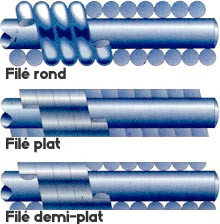
The winding type on electric guitar wound strings has a huge impact on tone and feel. Compared with most electric sets that use roundwound wraps, some electric strings use a flat wrap (flatwound) for a very soft, mellow tone and a super-smooth, quiet feel under the fingers.
Flatwound strings are mainly used in jazz, but they also work well for fingerstyle or on guitars built for slide playing.
There are also half-round (ground wound) strings. These start as roundwound and are polished on the outside to flatten the wrap. You get a compromise between the two, with a slightly darker tone and a less aggressive attack than roundwounds.
Treatment / coating
Treatments for electric guitar strings aim to extend string life. There are two main types: coatings that physically add a protective layer (see Elixir or D’Addario EXP, for example), and material-modification processes such as cryogenic treatment (see Dean Markley Blue Steel).
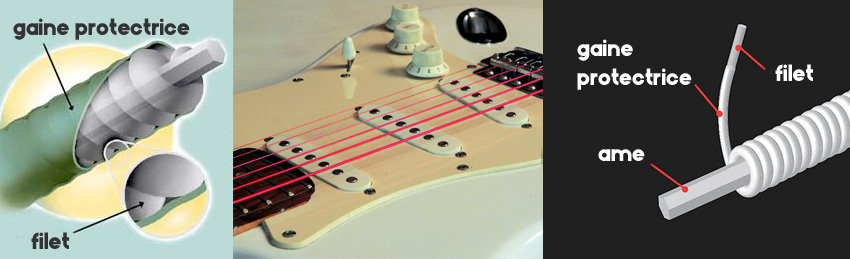
- Coating: applying a coating to strings was first done in 1997 by Elixir. The idea is to protect your electric strings from outside aggressors — especially oxidation from your fingers. Other major electric string brands have since created their own coating formulas (DR, for example, offers neon-colored treatments).
String life is greatly extended. The coating does change the feel, which seems softer and less “natural”. It also affects tone by reducing brightness and sustain. - Material modification: the best-known treatment that alters the string material (popularized by Dean Markley Blue Steel) is cryogenic processing — plunging the strings into liquid nitrogen at −160°C. This “tightens” the molecular structure and gives longer mechanical life. Tone becomes brighter and tuning stability improves. Unlike coatings, this does not protect against oxidation.
In the end
Choosing the electric guitar strings you like most is obviously very personal. Trying different gauges, materials, and brands is the only way to discover the set — or sets — that suit your style best. One last important point: the chemical interaction of your fingers with the strings varies from person to person, and should be factored into your choice of electric set.
